What to Expect at Your First Dry Needling Session for Muscle Knots
September 14, 2026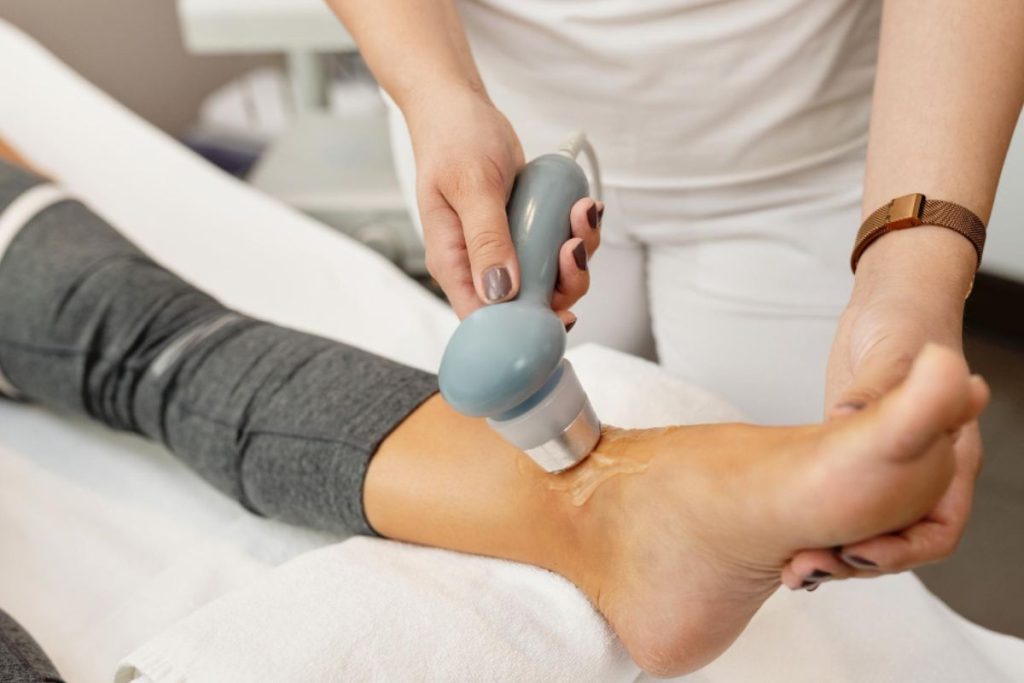
Plantar fasciitis happens when the plantar fascia, the thick band of tissue that connects your heel to your toes, becomes irritated and swollen. The most common sign is heel pain that hits hardest with your first steps in the morning. Rest, stretching, and physical therapy are usually tried first.
When those do not fully solve the problem, many people turn to shock wave therapy for plantar fasciitis, a non-surgical option with real research behind it. Studies show shock wave therapy works for roughly 65 to 91 percent of people with plantar fasciitis, though results build up over weeks rather than overnight.
This page walks through what real results look like, how long they take, and what to expect from your therapy at Dynamic Spine & Sport in Las Vegas.
Table of Contents
ToggleWhat Is Shock Wave Therapy for Plantar Fasciitis?
Shock wave therapy, sometimes called extracorporeal shock wave therapy or ESWT, sends focused pulses of acoustic energy into the sore part of your foot. This energy triggers your body’s own healing response and helps calm pain. Because it does not involve any cuts, it gives many people a way to treat plantar fasciitis without surgery. It does not work for everyone, and results can vary from person to person, so it helps to go in with realistic expectations.
Benefits of shock wave therapy include:
- No incisions or anesthesia
- No medication needed
- Short sessions with little to no downtime
- May help you avoid or delay surgery
- Works well alongside other treatments like stretching or orthotics
- Low risk of serious side effects
How Does Shock Wave Therapy Work for Plantar Fasciitis?
During a Las Vegas shock wave therapy session, your provider aims sound wave energy at the inflamed part of your foot. This creates tiny, controlled microtrauma in the tissue. That might sound like a bad thing, but this small disruption is exactly what tells your body to send healing resources to the area.
In response, your body can:
- Build new blood vessels, which brings more blood and nutrients to the injured tissue
- Calm nerve endings, which can ease pain right away for some patients
- Break down calcium buildup in the tissue
- Make cell walls more permeable, which helps healing happen faster
Because the treatment skips surgery entirely, it works well for people who want to avoid long-term medication or an operating room while still getting real relief from pain and stiffness.
Does Shock Wave Therapy Actually Work for Plantar Fasciitis?
Yes, for most people. Published studies report success rates between roughly 65 and 91 percent. One published study tracked patients over time and found real improvement in about 19 percent after one month, 70 percent after three months, and 98 percent after one year.
That slow climb explains why some people call it a scam online. Shock wave therapy is not a one-and-done fix, and judging it after a single session sets people up for disappointment. It also does not help everyone. But for those who complete the full course, the odds of real improvement are strong and backed by data, not marketing claims.
Signs You are a Candidate
You may be a good candidate for shock wave therapy if:
- Heel pain that has lasted several months without improving from rest, stretching, or orthotics
- Pain that is worse with your first steps in the morning or after sitting for a while
- A desire to avoid surgery or long-term medication
- Your provider also checks for open wounds, infection, or circulation problems in the treatment area during your consultation.
- Otherwise healthy enough for a non-invasive treatment
A consultation is the only way to know for sure whether shock wave therapy fits your case. Your provider reviews your health history and your foot before recommending treatment.
How Long Until You See Results?
Based on the research above, real improvement often builds steadily between 1 month and 3 months after starting treatment, with the fullest benefit showing up around the one-year mark. Some patients notice less pain within a few sessions. Most people see gradual relief over several weeks rather than an overnight change.
Note: Judging the treatment too early is one of the most common reasons people think it did not work.
How Many Shock Wave Therapy Sessions Will You Need?
Most people need three to 6 sessions spread out over several weeks. The exact number depends on how severe your plantar fasciitis is and how your body responds to treatment. Your provider builds a plan around your specific case rather than a one-size-fits-all number.
Preparation for the Treatment
Shock wave therapy does not require much preparation. Since it is non-invasive and does not use anesthesia, you do not need to arrange a ride home. Wear or bring shoes and socks that are easy to remove. Tell your provider about any blood thinners or anti-inflammatory medications you take, since these may need to be discussed before your first session. Most people drive themselves to and from treatment and go back to their normal day right after.
What Happens During a Shock Wave Therapy Session?
A typical session is simple and quick. Here is what to expect:
- You sit in a chair or lie on a table, depending on the area being treated
- Your provider applies a gel to your skin to help the sound waves transmit properly
- A handheld device delivers controlled acoustic pulses to the sore area
- You may feel a tapping or pulsing sensation, which is usually tolerable
- Most people return to normal activity right after, with little to no downtime
Sessions usually last 10 to 20 minutes, depending on the area being treated.
Post-Procedure Care and Instructions
Most people go right back to their normal day after a session. A few simple steps help you get the best results:
- Avoid intense exercise or long periods on your feet for the first 24 to 48 hours.
- Ask your provider whether to pause anti-inflammatory medication like ibuprofen after treatment, since it may affect the healing response the therapy is meant to trigger.
- Apply ice if you feel soreness at the treatment site.
- Keep up with any stretches or exercises your provider recommends between sessions.
- Wear supportive shoes and avoid walking barefoot on hard surfaces.
- Call your provider if pain, swelling, or bruising gets worse instead of better after a few days.
Following these steps between sessions helps your body use the full course of treatment instead of undoing progress in between visits.
Is Shock Wave Therapy Safe? Side Effects, Risks, and Complications
Shock wave therapy is generally considered safe when performed by a trained provider. Common, temporary effects include:
- Soreness at the treatment site
- Redness
- Bruising
- Mild swelling
Does shock wave therapy for plantar fasciitis hurt? Most people describe a tapping sensation that is uncomfortable but tolerable, not sharp pain.
Can shockwave therapy make plantar fasciitis worse? This is rare. Short-term soreness is far more common than any lasting setback. A consultation before your first session lets your provider check your health history and confirm the treatment is safe for you.
Shock Wave Therapy vs Other Plantar Fasciitis Treatments
| Shock Wave Therapy | Cortisone Shots | Laser Therapy | At-Home Devices | |
| Invasive? | No, uses acoustic pulses on the skin | Yes, an injection into the fascia | No, uses focused light on the skin | No, but low-powered and self-applied |
| Speed of relief | Gradual, builds over several weeks | Fast, often within days | Gradual, builds over several sessions | Varies, no clinical data to confirm |
| Long-term tissue healing | Often, supports real tissue repair in most patients | No, reduces inflammation but does not heal the tissue | Often, supports tissue repair in most patients | Unlikely, intensity is too low to trigger real healing |
| Repeat-use risk | Generally low, but your provider determines how many sessions are right for you | Can weaken or thin the fascia with repeated shots | Generally low, but your provider determines how many sessions are right for you | Unknown, no professional oversight to catch problems |
| Professional supervision | Yes, dosed and monitored by a provider | Yes, administered by a provider | Yes, dosed and monitored by a provider | No, used at home without guidance |
Does Insurance Cover Shock Wave Therapy for Plantar Fasciitis?
Coverage depends on your specific insurance plan. Some insurers cover shock wave therapy when it is medically necessary, while others treat it as an elective service.
Is shock wave therapy for plantar fasciitis covered by Medicare? Coverage varies by plan and requires documentation showing medical necessity. The best step is to confirm your coverage directly with your insurance provider and with our office before you begin treatment.
Shock Wave Therapy Results at Dynamic Spine & Sport in Las Vegas
Shock wave therapy is not an instant fix, but the research is real. Success climbs from about 19 percent in one month to 98 percent in one year, so a full course of treatment gives you the best odds.
At Dynamic Spine & Sport Rehabilitation in Las Vegas, we offer shock wave treatment for plantar fasciitis. Our founder, Joe Indrieri, serves on the Nevada Physical Therapy Board and is affiliated with the American Physical Therapy Association and the American Academy of Manual Therapists. He built our clinic around hands-on, personalized care, and our team applies that same approach to every patient we treat.
Ready to start treating your plantar fasciitis? Call our Las Vegas rehabilitation clinic at 702-685-1607 to schedule a consultation at one of our five convenient locations:
- Las Vegas (Rainbow Blvd)
- Henderson
- East Las Vegas (Lamb Blvd)
- Downtown Las Vegas
- Spring Valley
FAQs
Does shockwave therapy really work on plantar fasciitis?
Yes, for most people. Published studies show success rates between roughly 65 and 91 percent, depending on the study. Results build gradually over weeks rather than after a single session.
How much does shockwave therapy for plantar fasciitis cost?
Cost depends on the number of sessions you need and your insurance coverage. Call our office for exact pricing based on your specific case.
How long does it take for plantar fasciitis to heal after shockwave therapy?
Most people see gradual improvement over several weeks. Research shows steady gains between one and three months, with the fullest benefit often reached around one year.
Where can I get shockwave treatment for plantar fasciitis in Las Vegas?
Dynamic Spine & Sport offers shock wave therapy at five convenient Las Vegas area locations. Call 702-685-1607 or book online to schedule a consultation.
Is there a downside to shockwave therapy?
The main downsides are temporary soreness, redness, or bruising at the treatment site. It also does not work for every patient, so results can vary.

Related posts