Hyperbaric Oxygen for Ligament Injuries in Las Vegas
August 31, 2026
How Long Does Physical Therapy Take to Work?
September 7, 2026
Reviewed by Joseph E. Indrieri, MSPT, DPT
Last Updated: August 2026
Reading Time: 10 Minutes
Knee pain after a run or a long day on your feet is one of the most common complaints active adults bring to a physical therapist. Doctors call it patellofemoral pain syndrome, but most people know it as runner’s knee. The name is a bit misleading, since cyclists, hikers, and soccer players get it too.
The good news is that runner’s knee responds well to the right care, and surgery is rarely part of the picture. Most people improve with a clear plan built around rest, strength, and a few changes to how they train.
This guide covers what runner’s knee feels like, why it develops, how it differs from other common knee problems, and what a real recovery plan looks like from start to finish.
Table of Contents
ToggleWhat is a Runner’s Knee?
Runner’s knee (patellofemoral pain syndrome) happens when the kneecap does not glide smoothly against the end of the thighbone. That contact point is called the patellofemoral joint, which is where the medical name comes from. When the kneecap does not track well through its groove, the tissue around it gets irritated, and pain follows.
Runner’s knee does not have one single cause. It is a pattern that can build from several different sources, which is part of why it takes a careful exam to sort out and treat well.
Where Runner’s Knee Hurts
Pain sits at the front of the knee, around or just under the kneecap. Most people describe a dull, aching pressure rather than a sharp pain, though a grinding or clicking feeling can show up when the knee bends or straightens.
Runner’s Knee Symptoms
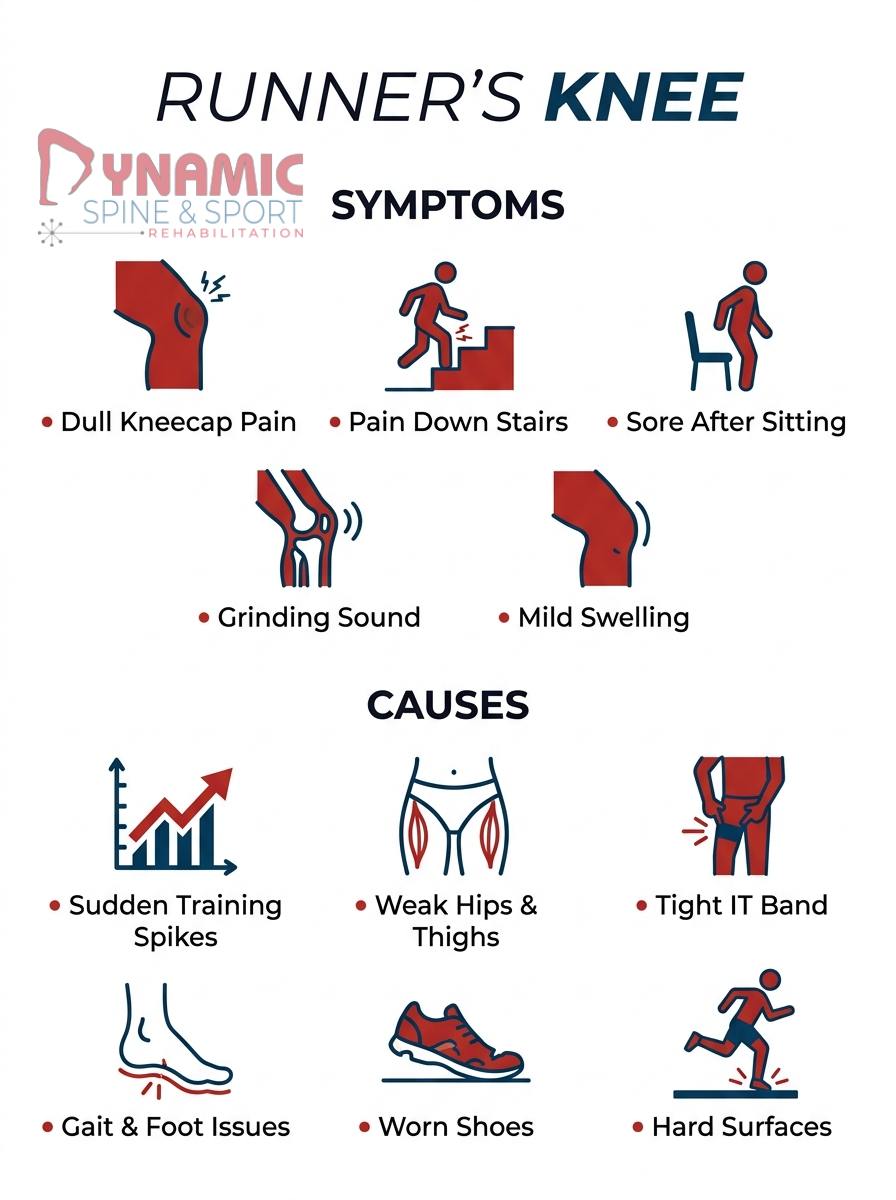
Most people describe a dull, aching pain around or behind the kneecap rather than a sharp, sudden pain. It tends to build gradually over days or weeks of training rather than appearing all at once.
Here are the signs to watch for:
- A dull ache around or under the kneecap during or after activity
- Pain that gets worse going down stairs or down a hill, more than going up
- Soreness after sitting with a bent knee for a long stretch, sometimes called moviegoer’s knee
- A grinding, clicking, or popping feeling when you bend or straighten the knee
- Mild swelling around the kneecap after activity
Pain usually eases with rest and returns once you go back to running, squatting, or climbing stairs. That pattern alone is a strong clue that you are dealing with a runner’s knee rather than a more serious structural problem.
Runner’s Knee Causes
Runner’s knee almost never comes from one single event. It builds from a mix of training habits and how your body moves under load. Here are the main contributors physical therapists look for:
- Sudden increases in training. A quick jump in mileage, speed, or hill work does not give your knee tissue time to adapt.
- Weak hip and thigh muscles. Your quadriceps and hip muscles help guide the kneecap along its groove. When they are weak or imbalanced, the kneecap can drift out of line.
- Tight muscles and connective tissue. A tight IT band or tight hamstrings can pull the kneecap off its normal path.
- Foot and gait issues. Flat feet, high arches, or a foot that rolls in when you land can change how force travels up through the knee.
- Worn or unsupportive shoes. Shoes that have lost their cushioning no longer absorb impact the way they should.
- Hard training surfaces. Concrete and other hard surfaces send more shock through the knee than a trail or track.
None of these causes are permanent. They are also exactly what a physical therapy plan is built to correct, which is why runner’s knee tends to respond well to conservative care.
The knee is part of a chain that runs from foot to hip. Weakness or tightness above or below the kneecap often shows up as pain at the knee itself, which is why a thorough exam looks beyond the kneecap before setting a treatment plan.
Runner’s Knee or Something Else?
| Condition | Where it hurts | What makes it worse |
| Runner’s knee | Around or under the kneecap | Stairs, squats, sitting a long time |
| IT band syndrome | Outside of the knee | Running, especially downhill |
| Jumper’s knee (patellar tendinitis) | Just below the kneecap | Jumping, sprinting, warms up with activity |
| Osteoarthritis | Deep in the joint, often both knees | Everyday activity, worse with age, stiff in the morning |
Self-diagnosis has real limits here, since several of these conditions can overlap or occur together. A person with weak hips, for example, can develop both a runner’s knee and a tight IT band at the same time, and treating only one may leave the other pain in place. A hands-on exam remains the most reliable way to sort out what is actually going on.
When to See a Physical Therapist or Doctor
Here are the situations that call for a visit rather than more waiting:
- Pain has lasted more than two to three weeks despite rest and activity changes.
- Your knee locks, catches, or feels like it might give out.
- You noticed a specific twist, fall, or impact right before the pain started.
- Swelling is significant rather than mild.
- Pain is present even at rest, not just during activity.
None of these signs mean something is seriously wrong. They simply mean an exam will get you a clearer answer and a faster path to feeling better than continuing to guess at home.
How Runner’s Knee Is Diagnosed
A Las Vegas physical therapist or doctor usually starts with your history: when the pain began, what activity brought it on, and what makes it better or worse. From there, a physical exam looks at how your knee moves, how strong your hip and thigh muscles are, and how you walk, squat, or land from a jump.
Imaging such as an X-ray or MRI is not usually needed at first. Most cases of runner’s knee are diagnosed through movement and strength testing alone. Imaging is reserved for cases that do not improve with a rehab plan, or where the exam points to something else, such as a meniscus tear or a kneecap alignment issue that needs a closer look.
Runner’s Knee Treatment Options
Treatment works best when it addresses both the pain itself and whatever is causing the kneecap to track poorly in the first place. Here is how a typical plan comes together.
Short-Term Relief
In the early days, cut back on the activities that flare up the pain, such as hard running or deep squats. Ice for fifteen to twenty minutes after activity can help calm swelling. This stage is about calming the knee down, not fixing the underlying cause.
Physical Therapy
This is the core of treatment for most people, and the part most likely to prevent the pain from returning. A therapist builds a plan around strengthening the quadriceps and hip muscles, since these support the kneecap and keep it tracking correctly. Many plans also include work on ankle and foot mechanics, since problems lower in the chain can show up as knee pain.
A few runner’s knee exercises commonly used in these plans include:
- Straight leg raises to build quad strength without stressing the joint
- Clamshells and side-lying leg lifts to strengthen the hip muscles
- Step-ups to train the knee and hip together under a real-world movement pattern
- Gentle stretches for the IT band, hamstrings, and calves
Supportive Options
A knee sleeve, patellar strap, or tape can ease discomfort for some people during activity. Research on braces is mixed, so think of these as a support during recovery rather than a fix on their own. Custom orthotics can help if flat feet or overpronation are part of the picture, and a physical therapist can tell you whether that applies to you.
When more advanced care is appropriate. A small number of cases do not improve with rehab alone. For those patients, tools such as orthopedic rehabilitation or additional diagnostic imaging may come into play, guided by how you respond to the initial plan.
How Long Does a Runner’s Knee Take to Heal?
The runner’s knee recovery time depends on how long you have had the pain and how consistently you follow a rehab plan.
| Case type | Typical timeline with a structured plan |
| Mild, caught early | Two to four weeks |
| Moderate, present for a month or more | Four to eight weeks |
| Recurring or long-standing | Two to three months, sometimes longer |
These ranges are general guides, not guarantees. Two people with the same symptoms can heal at different rates depending on their training load, strength, and how closely they stick with their exercises.
How to Prevent Runner’s Knee From Coming Back
Once your knee feels better, a few habits can lower the odds of the pain returning. Here are the changes that matter most:
- Increase mileage or intensity gradually, rather than jumping up all at once.
- Keep up hip and quad strength work even after symptoms clear, not just during flare-ups.
- Replace running shoes once the cushioning wears down, generally every three hundred to five hundred miles.
- Warm up before hard efforts instead of going straight into a fast pace.
- Mix in lower-impact days, such as cycling or swimming, to reduce total joint stress.
- Pay attention to early soreness and adjust training before it becomes real pain.
Runner’s knee is common, but it is not something you have to keep relearning to manage. A little consistency with strength work and training load goes a long way toward keeping it from coming back.
Effective Care for Runner’s Knee in Las Vegas
Dynamic Spine & Sport Rehabilitation treats runner’s knee with a plan built around the actual cause of your pain, not a generic handout. Our team evaluates hip and quad strength, gait, and foot mechanics, then builds a program that calms the pain and corrects the pattern behind it, so the knee stays strong once you return to full activity.
Our founder, Joseph E. Indrieri, MSPT, DPT, leads the clinic with over 20 years of physical therapy experience since 2003. He serves as a Nevada Physical Therapy Board (NVPTB) member for the 2024–2027 term and holds fellowship training through FAAOMPT and FAAMT. He is also a member of the American Physical Therapy Association (APTA) and the American Academy of Manual Therapists (AAMT).
If knee pain is holding you back, our team can help you get a clear diagnosis and a real path back to running, hiking, or your sport of choice. Call 702-685-1607 to schedule an evaluation at one of our locations, including 2230 N Rainbow Blvd in Las Vegas, 105 N Pecos Rd in Henderson, and 5495 S Rainbow Blvd in Las Vegas.
FAQs
Will runner's knee heal by itself?
Mild cases can ease with rest and time, but the pain often returns once activity picks back up unless the underlying weakness or tightness gets addressed.
Do I need knee replacement surgery?
No. Runner’s knee is a soft tissue and movement problem, not joint damage, and it responds to rest and strength work rather than replacement surgery.
Is walking good for runner's knee?
Yes, walking on level ground is usually well tolerated and can help you stay active while the knee heals.
Can non-runners get runner's knee?
Yes. Cyclists, hikers, and anyone who squats or climbs stairs often can develop the same pain pattern.
Can I keep running with runner's knee, or do I need to stop completely?
Many people can keep some activity going, as long as it does not increase the pain. A physical therapist can help you figure out how much to scale back rather than stopping altogether.
What is the fastest way to relieve runner's knee pain at home?
Cutting back on the activities that flare it up, applying ice after activity, and starting gentle hip and quad strengthening tend to bring the quickest relief.
Is walking okay if I have a runner's knee?
Walking on level ground is usually well tolerated, since it puts less stress on the kneecap than running, stairs, or hills.
How is runner's knee different from a meniscus tear or arthritis?
Runner’s knee causes a dull ache around the kneecap that builds with activity, while a meniscus tear often causes catching or locking, and arthritis tends to bring stiffness and pain that is present even without activity.